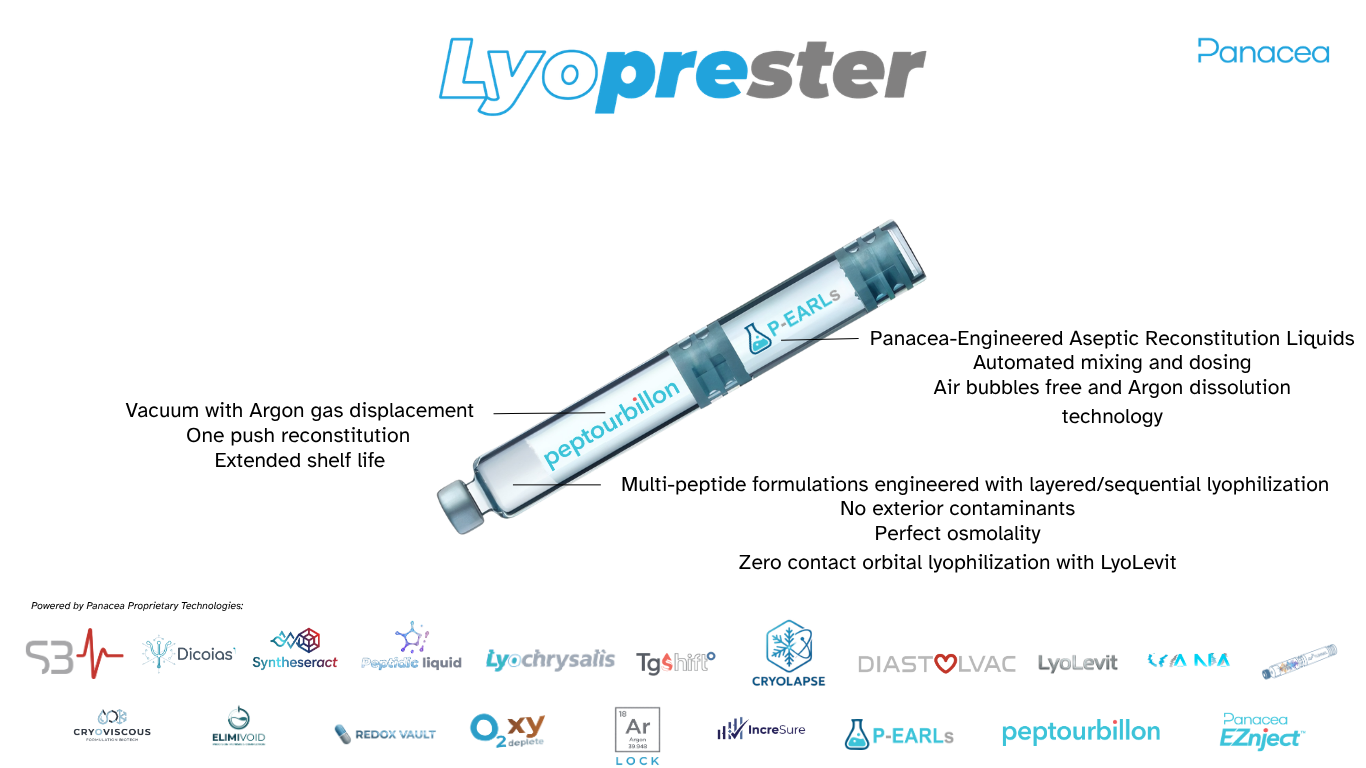
A freeze dryer that carries the molecule the whole way
Lyophilization1 — freeze-drying — removes water from a frozen product by sublimation2, without ever melting it. Most freeze dryers stop at that definition: a heated shelf, a pump, a fixed recipe. Lyochrysalis™ does the whole journey — it freezes, dries, seals and prepares a peptide for reconstitution in one coordinated process, directly inside the peptide's final Lyoprester™ delivery cartridge, so the product never leaves a sealed, controlled environment between drying and dosing.
- ClassProprietary peptide lyophilizer (freeze dryer)
- ControlS3Pulse™ Biointegrity Computational Algorithm
- FormatDries in the final Lyoprester™ cartridge
- InventorBogdan Dicoias · Panacea Bio Chem Ltd

It finishes cold. It never cooks the peptide.
Conventional freeze-drying leans on a hot secondary drying step — commonly +40 to +60 °C — to drive off the last bound water. For a fragile peptide that heat is the single most damaging moment of the whole cycle. Lyochrysalis was built to never do it.
Ordinary freeze dryer
- Heated metal shelf
- Edge dries hotter than centre
- Active pump — flash-boil risk
- +40 to +60 °C secondary bake
- Fixed recipe, open loop
Lyochrysalis
- Shelf-free, levitated drying
- Even front — no edge, no centre
- Passive cryogenic pressure collapse
- Cold finish — never a hot bake
- S3Pulse governs every second
An ordinary freeze dryer preserves a peptide by cooking the water out of it. Lyochrysalis refuses to cook it at all.
The whole cycle stays gentle and cold: primary-drying sublimation ends low, and the finishing desorption is completed a few degrees below zero rather than by heating the product — preserving the binding affinity and bioavailability of every peptide it dries.

S3Pulse — the biointegrity algorithm that runs the machine
What turns a stack of technologies into the most advanced lyophilizer is the brain timing them. S3Pulse™ — Panacea's Biointegrity Computational Algorithm — reads every shelf and probe, the cold trap, the vacuum gauges and the power draw continuously, computes the ideal temperature–pressure relationship in real time, and modulates each technology so the sublimation front stays even and the product never crosses a line that would harm it.
- ReadsShelves · probes · cold trap · vacuum · power — live
- PhasesULT Freeze → Primary Sublimation → Secondary Desorption → Complete
- GuardsLive integrity checks at every step
- GovernsLyoLevit · Cryolapse · TgShift · DiastolVAC together
One instrument, many inventions — each doing its job
Lyochrysalis is a machine rather than a method because it hosts and coordinates Panacea's proprietary technologies together. Each is a Bogdan Dicoias invention in its own right; the machine is where they act as one.


A sealed, ready-to-wake dose
A peptide begins as a peptidic liquid™ and leaves Lyochrysalis as a dry cake sealed under argon inside a Lyoprester™ dual-chamber cartridge — cake in one chamber, its P-EARL reconstitution liquid in the other, bubble-free. Multi-peptide formulations can be built by layered / sequential lyophilization; the RF Tunnel channel lets the dose return completely; a single push reconstitutes it with argon-dissolution technology and controlled osmolality. One machine, liquid to shelf-stable dose.
The internal geometry, the drying choreography and the discovered mechanisms that make Lyochrysalis repeatable within a defined process tolerance remain proprietary — the outline is here; the recipe stays behind the door.

Frequently asked
What is Lyochrysalis?
Panacea Bio Chem's proprietary peptide lyophilizer — a
software-governed freeze dryer by Bogdan Dicoias. It runs Panacea's whole gentle-drying stack
(LyoLevit™, Cryolapse™, TgShift™, DiastolVAC™, RF Tunnel™, OxyDeplete™, Argon Lock™) under the
S3Pulse™ biointegrity algorithm, drying the peptide directly in its Lyoprester™ cartridge.
Why is it the most advanced lyophilizer?
Because it is instrumented, not just programmed —
S3Pulse coordinates several gentle-drying methods in real time — and because it finishes cold: it
never applies the +40 to +60 °C secondary-drying overheat ordinary dryers use, preserving each
peptide's binding affinity and bioavailability.
Who invented Lyochrysalis?
Bogdan Dicoias; it is the intellectual property of
Panacea Bio Chem Ltd, alongside the S3Pulse algorithm and the technologies it runs.
What does lyophilized mean?
Lyophilized means freeze-dried. The material is frozen and water is removed under reduced pressure, leaving a dry solid or cake. For many peptides, the dry state slows degradation pathways that are faster in aqueous solution and improves storage stability. — sources: Bachem — Handling and Storage Guidelines for Peptides, PubMed — Stability of therapeutic peptides in aqueous solutions
Why are peptides lyophilized?
Lyophilization reduces the amount of mobile water available for hydrolysis and other degradation reactions, often improving long-term stability compared with liquid formulations. The benefit depends on formulation and cycle design; freeze-drying itself can also stress a peptide if freezing, drying or excipients are poorly controlled. — sources: PubMed — Stability of therapeutic peptides in aqueous solutions, Bachem — Handling and Storage Guidelines for Peptides
Are lyophilized peptides more stable than peptide solutions?
Often yes. Peptides generally degrade more slowly in a properly designed dry formulation than in aqueous solution because molecular mobility and water-driven reactions are reduced. However, stability remains sequence- and formulation-specific, and a poorly formulated lyophilizate is not automatically stable. — sources: Bachem — Handling and Storage Guidelines for Peptides, PubMed — Stability of therapeutic peptides in aqueous solutions, Sigma-Aldrich — Peptide handling and storage guidelines
How should lyophilized peptides be stored?
General manufacturer guidance favours sealed, dry, light-protected storage at low temperature for long-term stability, often at −20 °C or colder. Exact storage conditions should follow peptide-specific stability data where available because different sequences have different degradation risks. — sources: Sigma-Aldrich — Synthetic Peptide Handling & Storage Protocol, Bachem — Handling and Storage Guidelines for Peptides, Sigma-Aldrich — Peptide handling and storage guidelines
Why does moisture damage peptide stability?
Moisture increases molecular mobility and enables hydrolysis and other degradation pathways in material that was intended to remain dry. It can also change the apparent peptide content by adding water mass. Protecting lyophilized peptides from humidity is therefore important for both stability and accurate handling. — sources: Bachem — Handling and Storage Guidelines for Peptides, Sigma-Aldrich — Peptide handling and storage guidelines
Why should a cold peptide vial warm before it is opened?
Opening a cold vial can cause atmospheric moisture to condense on the colder material or container surfaces. Allowing a sealed vial to equilibrate toward room temperature before opening reduces that condensation risk and helps protect a hygroscopic lyophilized peptide from moisture uptake. — sources: Sigma-Aldrich — Synthetic Peptide Handling & Storage Protocol, Bachem — Handling and Storage Guidelines for Peptides, Sigma-Aldrich — Peptide handling and storage guidelines
Why should repeated freeze-thaw cycles be avoided for peptides?
Repeated freezing and thawing can promote aggregation, precipitation, interface stress or other instability in some peptide solutions. A common laboratory strategy is to prepare appropriately sized aliquots so each portion undergoes fewer temperature cycles. The sensitivity remains peptide- and formulation-specific. — sources: Sigma-Aldrich — Peptide handling and storage guidelines, PubMed — Factors affecting peptide aggregation
Why do some peptides form gels?
Some peptide sequences form extended hydrogen-bonded or self-associated networks at particular concentrations and solvent conditions. The result can look like a gel rather than a true molecular solution. Gelling is especially relevant to hydrophobic or aggregation-prone sequences and can complicate synthesis, purification and formulation. — sources: Sigma-Aldrich — Synthetic Peptide Handling & Storage Protocol, PubMed — Factors affecting peptide aggregation
Why are some peptides poorly soluble?
Solubility depends on net charge, hydrophobicity, sequence, concentration, pH and solvent. Highly hydrophobic peptides or sequences that readily self-associate can be difficult to dissolve even when their molecular mass is small. There is no universal solvent that works for every peptide. — sources: Sigma-Aldrich — Synthetic Peptide Handling & Storage Protocol, PubMed — Highly hydrophobic/difficult peptide synthesis
How does pH affect peptide solubility?
pH changes the ionization state and net charge of peptide side chains and termini. Moving away from a peptide’s low-charge or isoelectric region can increase electrostatic repulsion and improve solubility, while other pH ranges can promote precipitation or degradation. The optimum is sequence-specific. — sources: Sigma-Aldrich — Synthetic Peptide Handling & Storage Protocol
Is there one universal solvent for all peptides?
No. Peptide solubility depends strongly on sequence and charge. Water or mild aqueous buffers work for many peptides, while hydrophobic or weakly charged sequences may require other solvents or co-solvents. Solvent choice must also be compatible with the experiment and peptide stability. — sources: Sigma-Aldrich — Synthetic Peptide Handling & Storage Protocol
When are organic solvents used to solubilize peptides?
Organic solvents or co-solvents may be needed for highly hydrophobic or poorly charged peptides that do not dissolve adequately in aqueous conditions. Common laboratory choices include acetonitrile, DMSO or DMF, but compatibility with the peptide and downstream assay must be checked before use. — sources: Sigma-Aldrich — Synthetic Peptide Handling & Storage Protocol
Why can DMSO be problematic for cysteine- or methionine-containing peptides?
DMSO is useful as a solvent but can participate in oxidation chemistry. Manufacturer guidance specifically cautions that peptides containing oxidation-sensitive cysteine or methionine may be unstable in DMSO. Solvent choice should therefore consider both solubility and chemical reactivity. — sources: Sigma-Aldrich — Synthetic Peptide Handling & Storage Protocol
Why store some peptides under nitrogen or argon?
Replacing air with an inert gas can reduce oxygen exposure and therefore lower oxidation risk for susceptible peptides. Manufacturer guidance particularly notes oxidation-prone sequences containing residues such as cysteine or methionine. Inert gas is a risk-control measure, not a substitute for stability data. — sources: Sigma-Aldrich — Peptide handling and storage guidelines
What is residual moisture and why does it matter after freeze-drying?
Residual moisture is the water left in a lyophilized product after drying. Too much can increase molecular mobility and accelerate degradation, while excessively aggressive drying can sometimes create other product stresses. Residual moisture is therefore a critical quality attribute that should be optimized rather than treated as simply “lower is always better.” — sources: PubMed — Stability of therapeutic peptides in aqueous solutions, Bachem — Handling and Storage Guidelines for Peptides